Flexible Aquaculture Tanks: Complete Buyer's Guide for Fish Farming (2026)
If you’ve ever waited six months for a concrete pond to cure while your fingerlings outgrow their temporary holding, you already know why flexible aquaculture tanks exist. The traditional approach to fish farming infrastructure — concrete ponds, fiberglass tanks, earthen ponds — works. It has worked for decades. But it also locks you into permanent, capital-intensive installations that can’t adapt when your operation changes direction or when a site doesn’t pan out.
A flexible aquaculture tank solves a different set of problems. It’s a modular, relocatable tank built from industrial-grade PVC tarpaulin supported by a structural frame. You can deploy a 10,000-litre tank in an afternoon with two people. You can drain it, fold it, and ship it to another site when needed. And you can scale incrementally — add five tanks this quarter, ten next quarter — without pouring a single cubic metre of concrete.
SpaceBladder manufactures three distinct frame types for these tanks, each engineered for different operational profiles: PVC tarpaulin on a plastic tube frame for hatchery and nursery work, PVC tarpaulin on a hot-dip galvanized steel tube frame for commercial grow-out, and PVC tarpaulin on galvanized steel sheet panels for rapid-deployment scenarios. The common thread is the liner — a welded PVC tarpaulin rated for continuous water contact in food-fish production, tested to SGS standards for 173 substances.
This guide walks through every decision point in specifying a flexible fish farming tank for your operation. By the end, you’ll know which frame type fits your production model, what site preparation is actually required, what the total cost of ownership looks like compared to traditional ponds, and exactly what information you need to send for an accurate quotation.
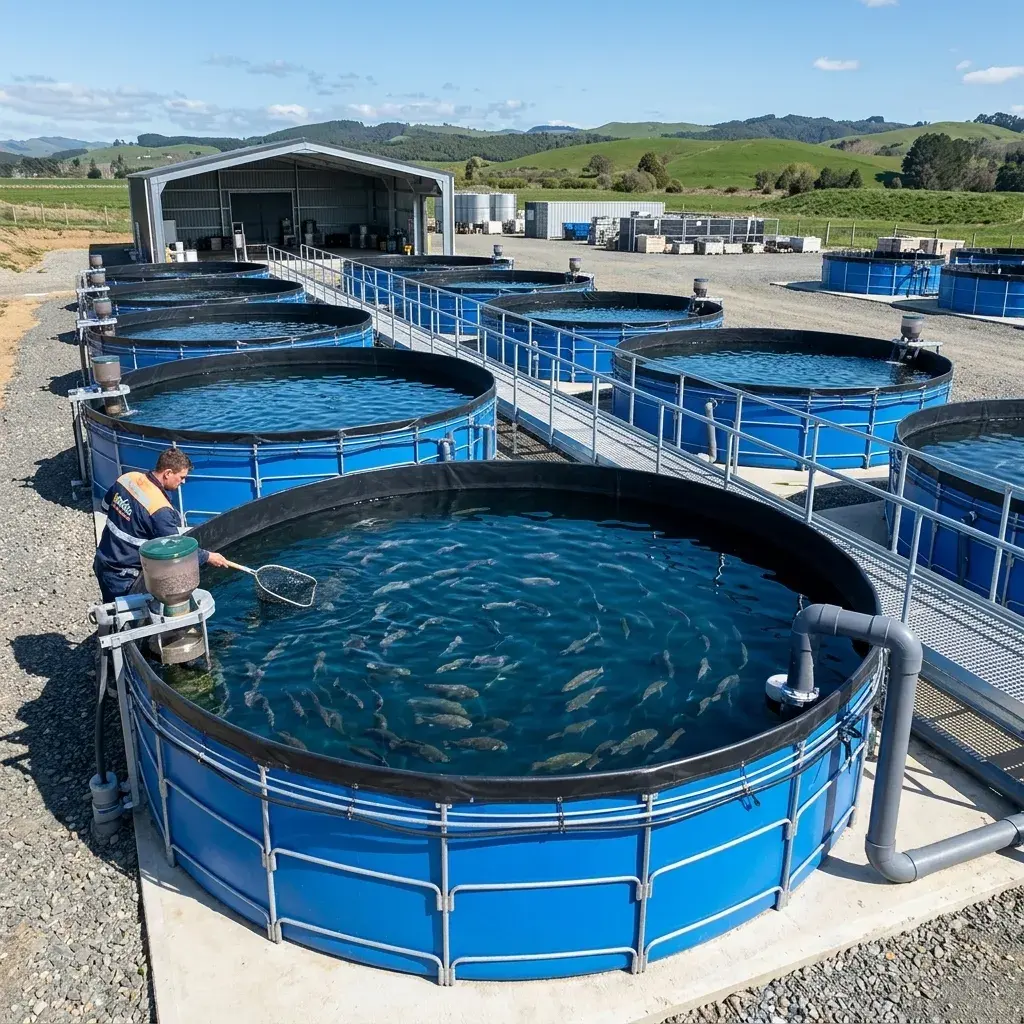
1. What Is a Flexible Aquaculture Tank?
A flexible aquaculture tank is a portable containment vessel for fish production, consisting of two components: a welded PVC tarpaulin liner that holds the water, and a structural frame that holds the liner in shape. Unlike rigid tanks made from fiberglass, concrete, or molded polyethylene, the liner is pliable — it ships folded, unfolds on site, and adapts to the frame geometry.
The concept isn’t new. Flexible membrane containment has been used in industrial liquid storage for decades — fuel bladders, water storage pillows, chemical containment berms. Applying the same engineering principles to aquaculture simply meant developing a liner material that meets food-safety requirements while standing up to continuous water exposure, UV radiation, fish waste chemistry, and mechanical stress from cleaning operations.
SpaceBladder’s approach relies on high-frequency welding technology: the liner panels are joined under intense pressure and electromagnetic energy, melting the PVC layers together to form a single, inseparable bond. This isn’t cosmetic — a properly executed high-frequency weld is the structural difference between a seam that holds for years and one that becomes a failure point after months of hydrostatic pressure.
The three frame types share this liner technology but differ in the support structure:
-
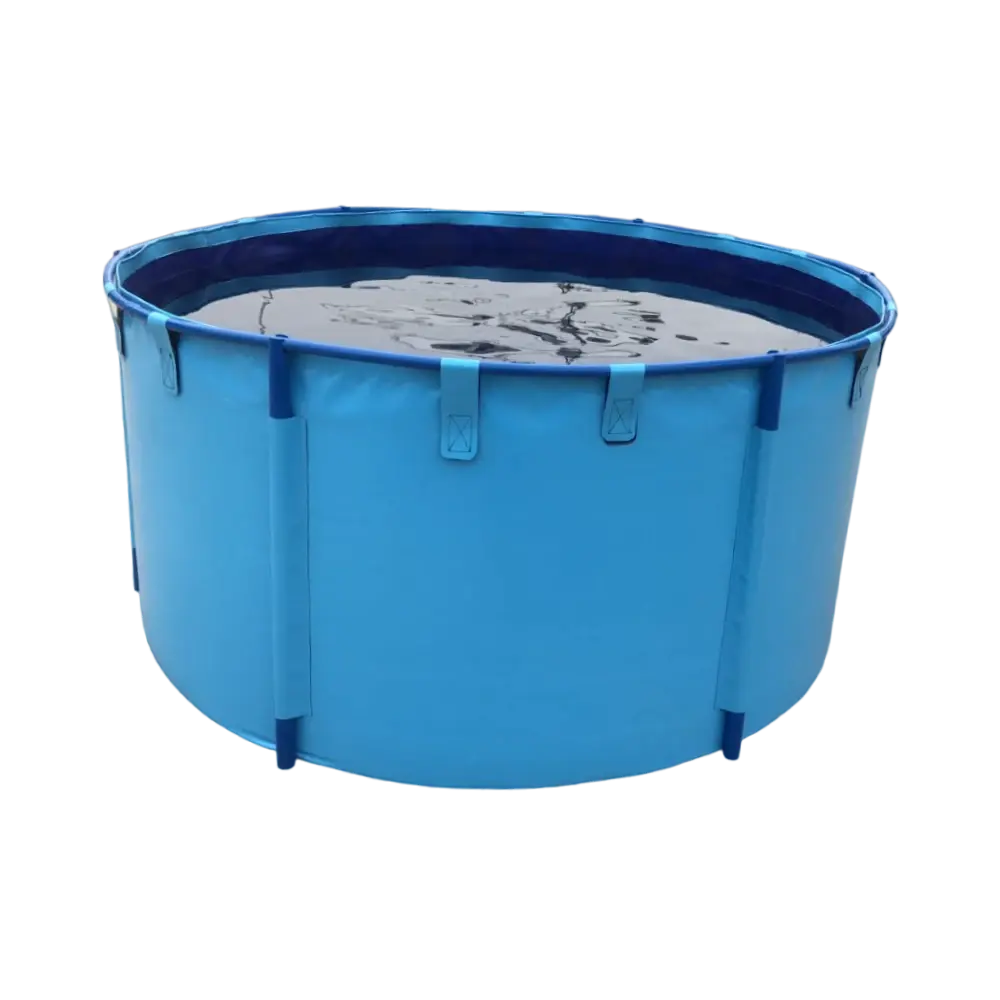
Type A (Plastic Tube Frame): PVC or PE pipe segments form a lightweight skeleton. These assemble with push-fit connections — no tools beyond a rubber mallet. The liner drapes inside, and the water pressure completes the structural lock. Best suited for indoor hatcheries, breeding programmes, and nursery operations where tank weight matters and load-bearing isn’t extreme.
-
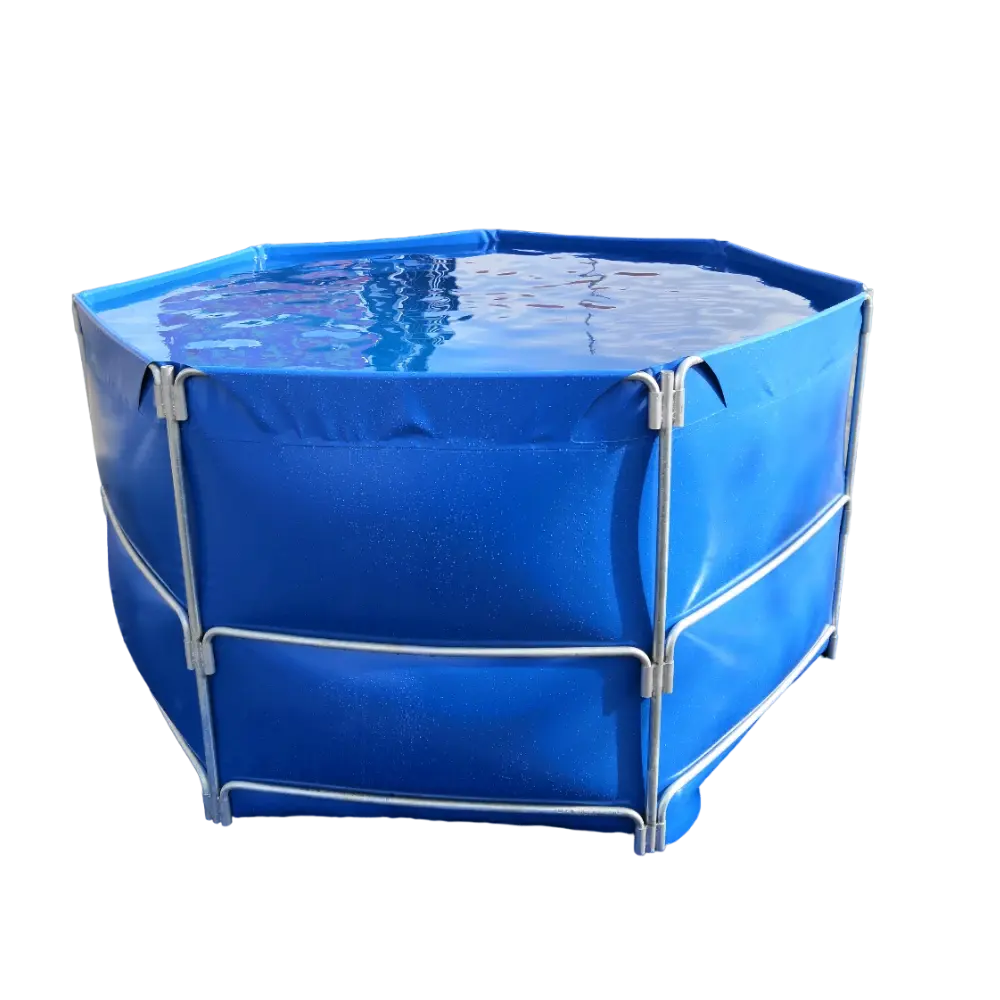
Type B (Galvanized Steel Tube Frame): Hot-dip galvanized steel pipes — DN25 verticals with 2.5mm wall thickness, DN20 horizontals with 2.0mm wall — form a rigid circular cage. This is the commercial grow-out workhorse. The galvanized frame distributes hydrostatic pressure evenly across the liner and withstands outdoor exposure for 8+ years.
-
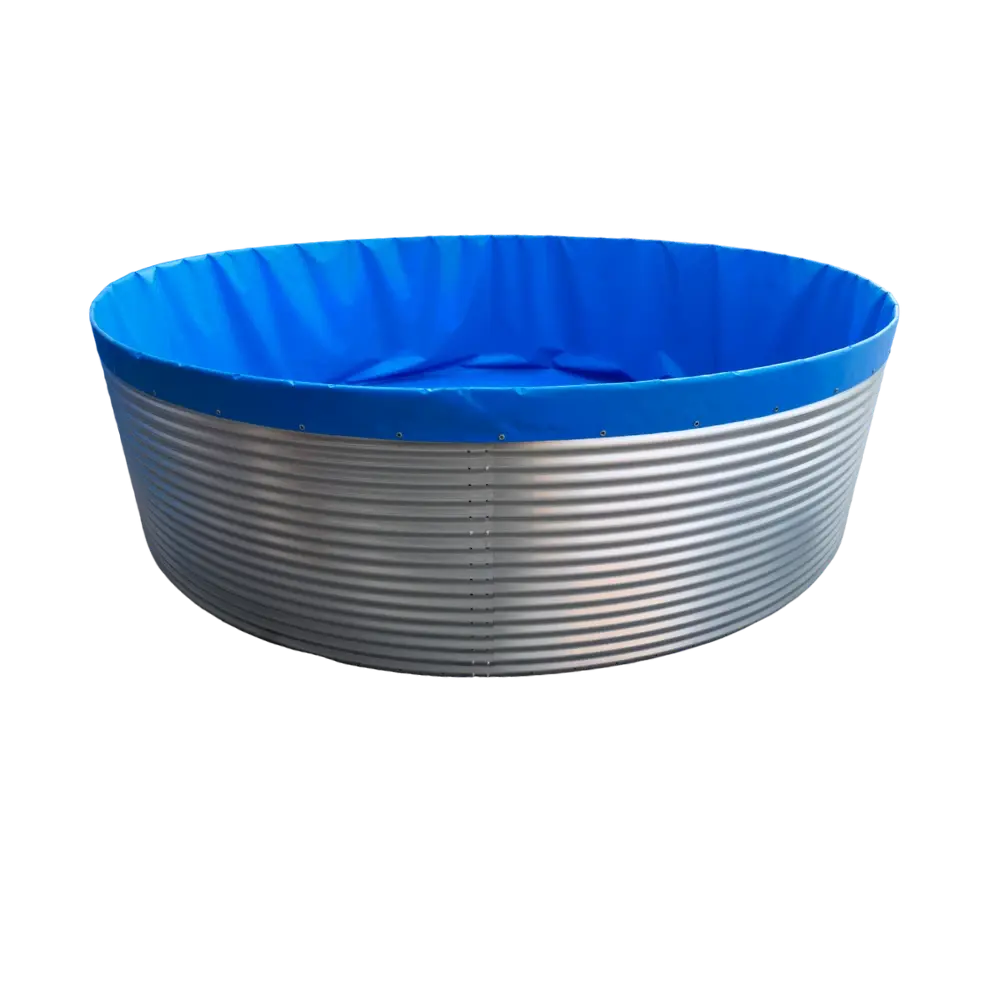
Type C (Galvanized Steel Sheet Frame): Corrugated galvanized steel sheet panels bolt together edge-to-edge, forming a cylindrical shell. The PVC liner sits inside. This is the rapid-deployment option — two workers can assemble a tank in a single day without cranes or heavy equipment.
All three types share a temperature tolerance of -30°C to 70°C, a standard 2-inch ball valve drain (with optional 4-inch/110mm upgrade for larger volumes), and a 1-year warranty backed by production lead times of 7-15 working days.
The key distinction from traditional infrastructure is portability and speed. A concrete pond takes weeks to pour and months to cure. An earthen pond requires heavy earthmoving equipment and ongoing berm maintenance. A flexible aquaculture tank arrives on a pallet and holds water the same day you unload it. For operations that need to scale quickly, test a new site, or maintain the option to relocate, that speed translates directly into production uptime.
2. The Three Frame Types: How to Choose
Choosing the wrong frame type is the most expensive mistake you can make in specifying a flexible aquaculture tank. The liner material is the same across types. What changes is the frame’s structural performance, assembly time, portability, and lifespan — and each type maps to a different operational profile.
Frame
Tube Frame
Sheet Panels
Type A: PVC Tarpaulin + Plastic Tube Frame
This is the entry point. The frame consists of interlocking plastic pipe segments — lightweight enough that one person can carry an entire 2,000L tank frame across a warehouse floor. Assembly is push-fit: slide the horizontals into the verticals, tension the ring, drape the liner. No fasteners, no tools.
Standard sizes: 500L, 2,000L, 3,000L, 5,000L, 8,000L, 10,000L, 15,000L, 20,000L, 30,000L, 40,000L — with 5,000L and 10,000L being the most commonly ordered sizes for hatchery applications.
Material specs: 0.7mm to 1.5mm PVC tarpaulin liner, depending on tank volume and water depth. Larger tanks use thicker material to manage the increased hydrostatic load at the base.
Lifespan: 7+ years under normal use conditions. Indoor installation extends this further by eliminating UV degradation as a factor.
Best for: Indoor hatcheries, breeding tanks, nursery tanks, quarantine systems. Any application where the tank is protected from weather extremes and the primary requirement is reliable containment at low cost.
Limitations: Plastic frames aren’t designed for high-wind outdoor exposure or heavy mechanical stress. If your site gets typhoon-level winds or your operation involves frequent netting from the tank perimeter, step up to Type B.
The plastic tube frame fish tank product page has detailed specifications for each standard size.
Type B: PVC Tarpaulin + Galvanized Steel Tube Frame
Type B frames use hot-dip galvanized steel pipe — DN25 (33.7mm) vertical posts with 2.5mm wall thickness, connected by DN20 (26.9mm) horizontal rails with 2.0mm wall thickness. This is the commercial production workhorse. The galvanized coating is applied after fabrication, so cut edges and weld points are fully protected.
Standard sizes: 500L through to 200,000L. The most frequently deployed sizes for grow-out are 10,000L, 20,000L, 30,000L, 40,000L, 80,000L, and 120,000L. At the upper end, a 300,000L tank is available for operations that need near-pond-scale capacity without the permanence of concrete.
Safety certification: The PVC liner material has been tested to SGS standards for 173 substances and is certified fish-safe. This matters if your buyers require documentation — export-oriented aquaculture operations increasingly need to demonstrate food-safety compliance throughout the production chain.
Lifespan: 8+ years under normal use. The liner is the wear component; the galvanized frame typically outlasts two liner replacements.
Best for: Commercial grow-out operations, outdoor installations, high-density production, any scenario where tank failure would mean lost production revenue. If you’re producing tilapia, catfish, or carp at commercial scale and your tanks sit exposed to sun and rain, Type B is the correct specification.
Limitations: Heavier than Type A — a 30,000L frame weighs enough that you’ll want a pallet jack or small tractor for positioning. Assembly time is longer: expect 2-4 hours for a 10,000L unit with two people, versus 1-2 hours for the equivalent Type A.
For full specifications, see the collapsible commercial circular aquaculture tanks product page.
Type C: PVC Tarpaulin + Galvanized Steel Sheet Frame
This is the fast-deployment option. Instead of individual pipe segments, the frame is built from corrugated galvanized steel sheet panels that bolt together edge-to-edge to form a cylindrical shell. The liner sits inside the shell.
Standard sizes (SBGST models): 8,300L, 12,000L, 15,000L, 22,000L, 30,000L, 45,000L, 55,000L, 80,000L, 112,000L — nine standard sizes covering small to large applications.
Assembly speed: Two people can assemble one tank in a day. The bolt-together panel design eliminates the pipe-connecting step entirely. For temporary sites, seasonal production, or rapid scaling scenarios, this assembly speed is the primary selling point.
Material specs: 0.5mm to 1.5mm PVC tarpaulin liner with galvanized steel sheet panels. Panel thickness increases with tank diameter and water depth.
Lifespan: 8+ years. The heavy-duty corrugated galvanized steel sheet panels offer exceptional structural rigidity and rust resistance, making this tank highly durable for long-term commercial operations.
Best for: Permanent commercial aquaculture sites, large-scale fish farming facilities, and any operation that requires rapid assembly without sacrificing long-term durability and structural strength.
Limitations: Because the structure is made of rigid steel panels, it is heavier to transport than the plastic tube frames and requires a level, prepared foundation for proper installation. The bolt-together panel joints also need initial careful assembly to ensure perfect alignment.
See the galvanized steel sheet aquaculture tanks product page for the full SBGST model table.
Decision Guidance
The frame type question reduces to three variables: how long you need the tank to last, how fast you need it deployed, and whether it lives indoors or outdoors.
If you’re running an indoor hatchery and need 5,000L tanks for fry rearing, choose Type A. The lower cost per tank lets you deploy more production units within the same capital budget, and the indoor environment eliminates the weathering concerns that would push you toward steel.
If you’re scaling a commercial grow-out operation and your tanks will sit outdoors year-round, Type B is your workhorse. The galvanized steel frame justifies its higher unit cost through longer service life and structural integrity under continuous loading.
If you need to deploy a production site within a week — seasonal tilapia grow-out, a research trial, emergency relocation of stock — choose Type C. Accept the shorter lifespan as a feature, not a bug: you’re paying for speed.
3. Manufacturing and Safety Standards
The liner is the heart of a flexible aquaculture tank, and the manufacturing process determines whether it holds water for a decade or develops seam leaks within a season.
PVC tarpaulin construction: SpaceBladder uses multi-layer PVC tarpaulin in thicknesses from 0.5mm to 1.5mm, selected according to tank volume and hydrostatic pressure at the maximum fill depth. The UV stabilizer is compounded into the PVC during extrusion — no aftermarket coating, no peeling, no layer degradation. The inner surface is formulated for continuous freshwater contact without leaching.
High-frequency seam welding: PVC tarpaulin panels are joined by high-frequency welding, which creates a molecular bond between the PVC layers. Unlike stitched or glued seams, this fabrication technique ensures that the seam is as strong as the base material itself. In practice, a properly executed high-frequency welded seam eliminates the risk of peel stress failure; the material will tear before the welded seam separates.
SGS testing: The PVC liner material has been tested by SGS for 173 substances. This is relevant because flexible tanks in food-fish production sit at the intersection of materials science and food safety regulation. European and North American importers increasingly require documentation that product-contact materials don’t introduce contaminants into the production chain. The SGS test report provides that documentation. SpaceBladder can supply the test certificate on request.
Quality control: Every tank undergoes a water-fill pressure test before crating. The tank is filled to capacity and held for a specified period while inspectors check every seam and the drain valve fitting. A tank that leaks in the factory doesn’t ship.
Operating temperature range: -30°C to 70°C. The lower bound matters for operations in cold climates — the PVC remains flexible well below freezing, so drained and stored tanks survive winter without cracking. The upper bound matters for outdoor installations in tropical and subtropical regions, where direct sunlight can push standing water temperatures high. The material tolerates the heat, but fish won’t; temperature management (shading, water exchange) remains an operational concern regardless of tank material.
Color options: Military green, white, blue, black, and dark green are standard. Color choice has practical implications: white and light colors show algae buildup faster and reflect more solar radiation, keeping water temperatures marginally lower; black and dark green absorb heat and can extend the growing season by a few degrees in cooler climates. Military green is the most popular choice for outdoor commercial installations because it balances heat absorption with UV resistance and blends into rural surroundings.
4. Flexible Tanks vs. Traditional Ponds: Total Cost of Ownership
Purchase price is the wrong metric for comparing aquaculture infrastructure. A concrete pond costs more to build. An earthen pond costs more to maintain. A flexible tank costs more to replace. The number that matters is total cost of ownership over the production horizon — typically five to ten years for a commercial aquaculture operation.
Here’s how the three options stack up across the dimensions that affect your balance sheet:
| Factor | Flexible Aquaculture Tank | Concrete Pond | Earthen Pond |
|---|---|---|---|
| Capital cost (per m³) | Moderate — liner + frame, no civil works | High — formwork, rebar, concrete pour, curing time | Low to moderate — excavation, compaction, possible liner |
| Installation time | 2 people × 2-4 hours per tank | Weeks (pour) + months (curing) | Days to weeks (earthmoving) |
| Relocation possible? | Yes — drain, fold, move, reassemble | No — permanent structure | No — permanent excavation |
| Biosecurity | High — smooth PVC surface, easy to disinfect between cycles | Moderate — concrete is porous, biofilm builds up in micro-cracks | Low — soil-borne pathogens, wild fish intrusion, bird predation |
| Water management | Controllable — integrated drain, known volume, predictable circulation | Controllable but fixed — drain position set at construction | Limited — seepage, evaporation, runoff contamination |
| Scalability | Incremental — add tanks one at a time as production grows | Lumpy — build a pond now for capacity you might need in three years | Lumpy — same constraint as concrete |
| Maintenance (annual) | Low — liner inspection, frame bolt check, drain valve test | Medium — crack repair, resurfacing, drain cleaning | High — berm repair, silt removal, vegetation control, predator exclusion |
| Service life | 7-8+ years (liner replaceable independently of frame) | 20+ years (with maintenance) | Indefinite (with continuous maintenance) |
| Permitting | Generally minimal — above-ground temporary structure | Significant — building permits, drainage plans, environmental assessment | Significant — earthworks permits, water rights, environmental impact |
A worked example: A 10,000L grow-out tank for tilapia production. Type B flexible tank: approximately one day from pallet to production, deployable on compacted earth or a simple concrete pad. Concrete pond of equivalent volume: four to six weeks of construction, plus a minimum 28-day curing period before fish can be introduced. The flexible tank produces fish for two months while the concrete pond is still curing.
The trade-off is longevity. A well-built concrete pond can serve for 20 years. A Type B flexible aquaculture tank gives you 8+ years, after which you replace the liner (the frame typically doesn’t need replacement). Spread the capital cost over the production period and add the time-to-production advantage, and the flexible tank often comes out ahead on net present value — particularly for operations that need to generate revenue quickly.
For the most detailed comparison of aquaculture containment options, the fish farming tank category page covers all product types with specification tables.
Trying to decide between Type A, B, or C for your site? Send us your capacity requirements and installation environment. We'll recommend the right configuration — no obligation.
Get a Frame Type Recommendation →5. Application Scenarios
Different production models demand different tank specifications. Here are the six most common scenarios SpaceBladder sees, with recommended configurations for each.
Hatchery and Nursery
Hatcheries need clean, controllable volumes where fry and fingerlings can be monitored closely. Tank capacity typically ranges from 700L to 2,000L, with water depth kept moderate (0.6m-1.0m) for easy observation and netting.
Recommended: Type A (plastic tube frame), 1,000L-2,000L. The lightweight frame is easy to reposition in an indoor facility, and the smooth PVC surface supports rigorous biosecurity protocols between batches.
Reference case: A 700L indoor plastic fish breeding tank (1.2m diameter, 0.6m height) deployed in a hatchery environment.
Commercial Grow-Out
This is where flexible aquaculture tanks compete most directly with ponds. Grow-out requires volumes of 5,000L to 30,000L and beyond, with tanks exposed to outdoor conditions year-round.
Recommended: Type B (galvanized steel tube frame), 10,000L-30,000L. The galvanized frame handles weather, the liner thickness (typically 1.0mm-1.5mm) manages the hydrostatic load at depth, and the 8+ year service life aligns with commercial investment horizons.
Reference case: A 5,000L fish cultivation tank (2.6m diameter, 0.95m height) in active grow-out production.
Large-Scale Commercial Production
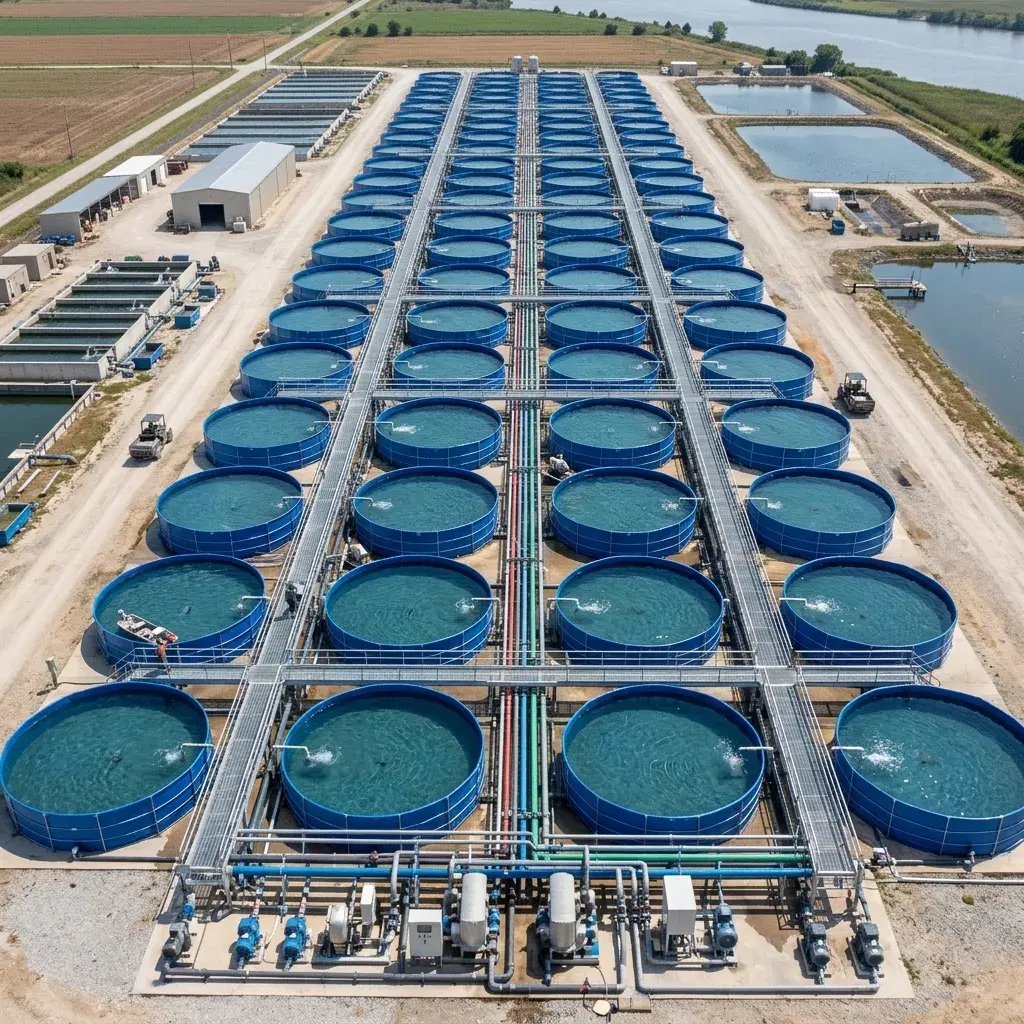
Operations producing 100+ tonnes annually need tank volumes above 30,000L — approaching small pond scale but with the management advantages of tank-based production.
Recommended: Type B (up to 200,000L) or Type C (up to 112,000L), depending on permanence. Type B for permanent installations; Type C if the site is developing incrementally.
Shrimp Farming
Shrimp present specific tank requirements: shallower water depth, larger surface area for benthic activity, and compatibility with brackish or full-salinity water.
Recommended: Type B with custom depth specification. The galvanized steel frame supports the wide-diameter, shallow-depth geometry that shrimp production requires. Material compatibility with salt water must be confirmed during specification — see Chapter 9 for saltwater considerations.
Reference case: A foldable aquaculture tank for shrimp farming with a steel-plastic frame configuration customized for shrimp production parameters.
Aquaponics Integration
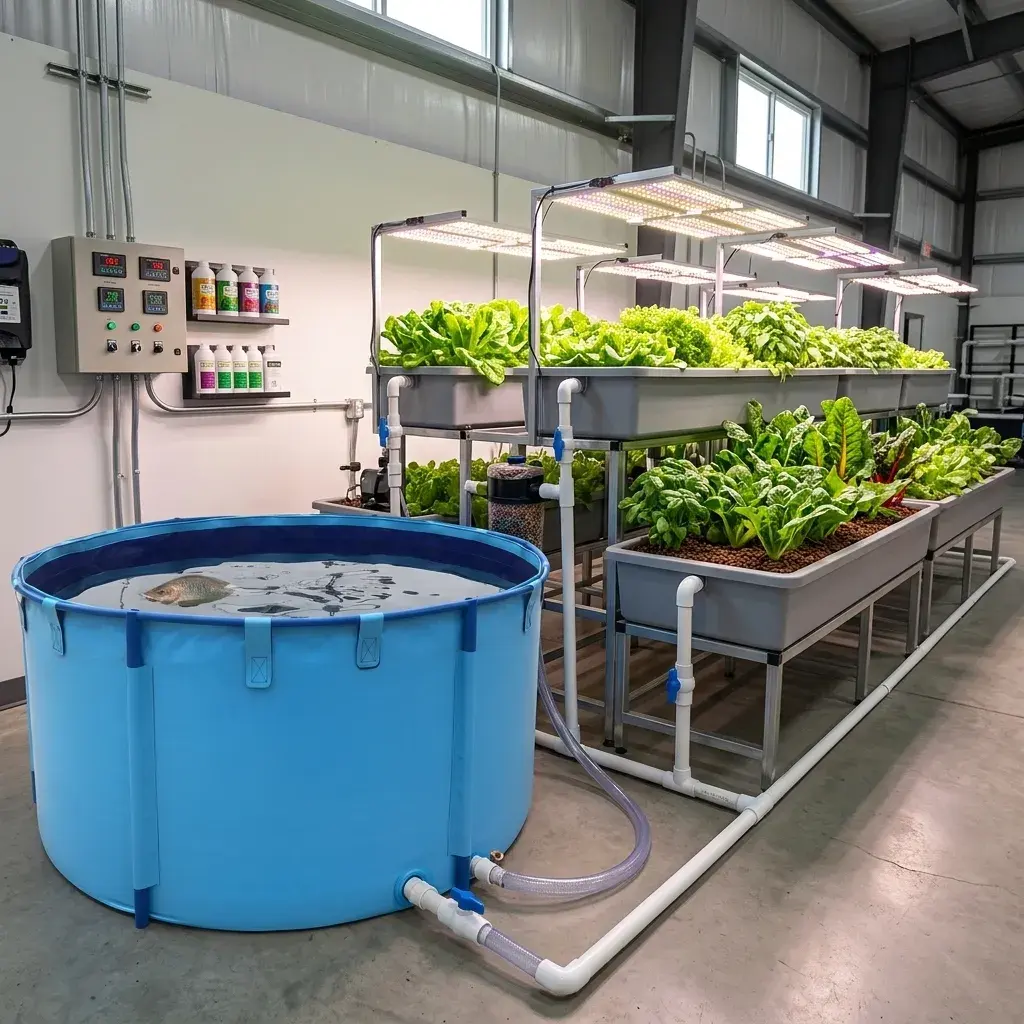
Aquaponics systems pair fish tanks with hydroponic grow beds in a recirculating loop. The tank needs plumbing integration points for the circulation pump and return line, and the volume must be sized to balance the grow bed capacity.
Recommended: Type A or Type B, depending on scale. A backyard or educational aquaponics system might use a 1,000L Type A tank; a commercial aquaponics operation producing leafy greens and tilapia at scale would spec Type B tanks at 5,000L-10,000L with customized inlet/outlet positions.
Home and Small-Scale Production
Not every buyer runs a commercial operation. Some are establishing a family-scale production unit, a demonstration site, or a pilot project before committing to larger investment.
Recommended: Type B steel tube frame at 3m diameter (approximately 7,000L-10,000L depending on height). The steel frame provides outdoor durability without the cost premium of larger commercial volumes, and the tank serves as a representative unit for scaling decisions.
Reference case: A customized fish farming tank built from client feedback, adapted to specific site and production requirements.
6. Installation and Site Preparation
Installing a flexible aquaculture tank isn’t complicated, but skipping the site preparation steps is the most common reason for premature liner wear and frame misalignment.
Site Requirements
The ground under the tank carries the full water weight. A 10,000L tank holds 10 tonnes of water. If the ground settles unevenly, the frame distorts and the liner experiences point loading — the fastest route to a seam failure.
Minimum site conditions:
- Level ground: Within 2cm of grade across the tank footprint. Use a laser level or string line to verify.
- Drainage: The area should shed rainwater, not collect it. A slight slope away from the tank position is ideal.
- Water source proximity: Close enough to fill the tank without excessive hose runs; far enough that plumbing leaks don’t saturate the ground under the tank.
- Access: You’ll need to walk around the tank for feeding, monitoring, and maintenance. Allow at least 1m clearance on all sides.
Foundation options:
- Compacted earth: Lowest cost option. Remove vegetation, compact with a plate compactor, cover with a groundsheet. Adequate for Type A and Type B tanks up to 10,000L on stable soil.
- Sand base: 5cm-10cm of compacted sand over leveled earth. Better load distribution, particularly for larger tanks.
- Concrete pad: Best for permanent installations. 10cm minimum thickness, rebar-reinforced, with integrated drainage channel. Recommended for Type B tanks above 30,000L.
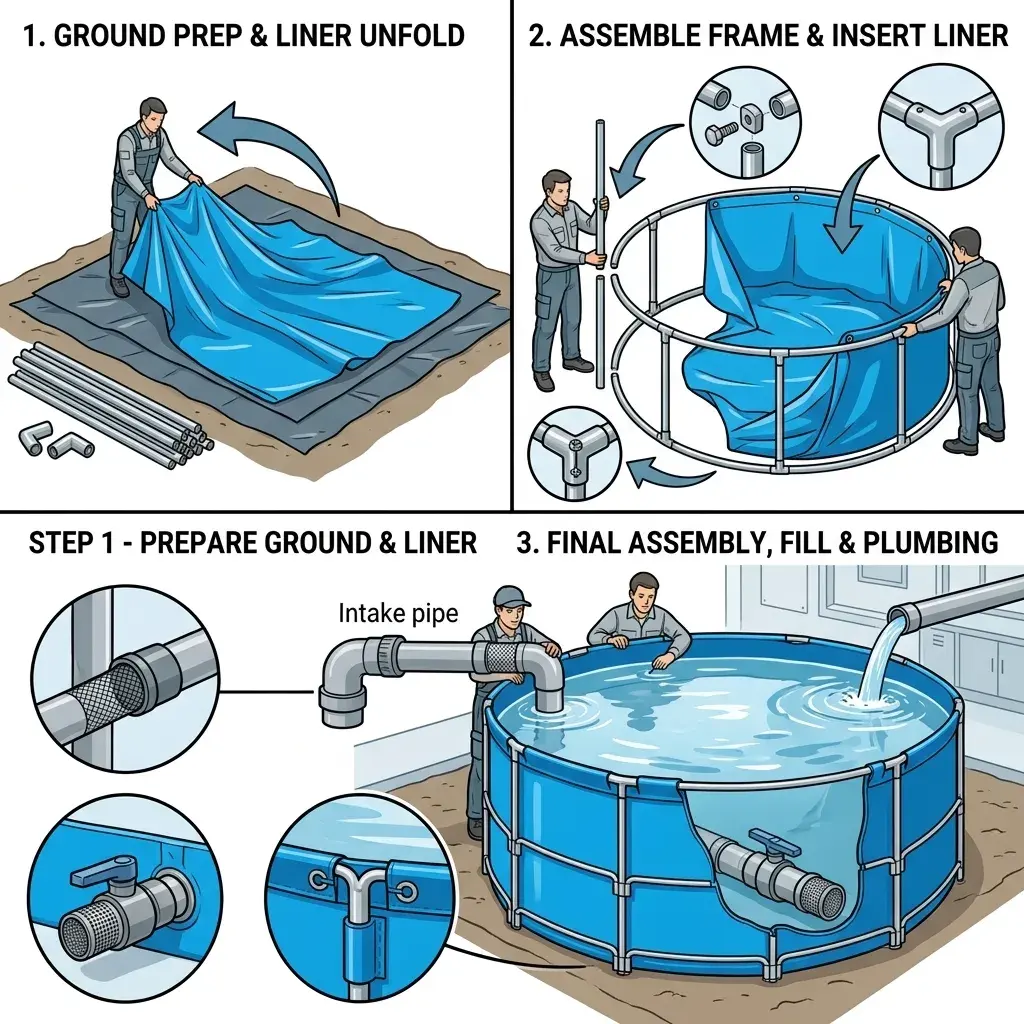
Assembly Sequence (Type B, 10,000L example)
- Lay the groundsheet on the prepared foundation, extending 30cm beyond the tank perimeter on all sides.
- Assemble the frame ring: connect DN25 vertical posts to DN20 horizontal rails. Insert locking pins or bolts at each joint. Do not fully tighten until the ring is complete and circular.
- Position the frame on the groundsheet, verify it’s centered, and tighten all connections.
- Unfold the PVC liner inside the frame. Spread it evenly, working wrinkles outward from the center. The liner skirt should drape over the top rail.
- Secure the liner to the top rail using the integrated attachment system (varies by model — some use grommets and ties, others use a sleeve-and-insert design).
- Install the drain valve through the pre-cut outlet port in the liner. Hand-tighten, then add a quarter-turn with a wrench. Overtightening damages the fitting gasket.
- Connect inlet plumbing and any aeration lines through the designated ports.
- Begin filling. As water rises, adjust the liner drape to eliminate folds that could become stress concentrators under pressure. Check all seams for seepage during the first fill.
Two people, basic hand tools (adjustable wrench, rubber mallet, screwdriver), approximately 2-3 hours for a 10,000L Type B tank. Type A assembles faster (1-2 hours); Type C takes longer (4-6 hours) but requires no pipe-fitting — just panel bolting.
7. Accessories, Plumbing, and Customization
The standard tank ships with a 2-inch ball valve drain. That covers the most common use case, but most commercial installations need more than a drain.
Drain options: The standard 2-inch (50mm) ball valve handles everyday water exchange and tank draining for volumes up to approximately 30,000L. Above that, or for operations where rapid draining matters (emergency harvest, biosecurity flush), a 4-inch (110mm) drain is available as an upgrade. The larger drain shortens drain time significantly — a 50,000L tank drains in roughly 45 minutes through a 110mm outlet versus several hours through a 50mm.
Inlet and outlet customization: Standard inlet/outlet positions are specified per model, but SpaceBladder accepts custom placement diagrams. If your water supply line enters from a specific wall or your recirculation system return needs to be at a particular height, provide the specification at order. Custom port positions add a few days to production lead time but eliminate the need for awkward plumbing adaptations on site.
Aeration integration: Most commercial aquaculture tanks run with supplemental aeration — air stones, diffuser grids, or paddlewheel aerators for larger volumes. The tank frame can support mounting brackets for aeration equipment, and the liner can accommodate sealed cable or airline penetrations. Specify aeration requirements at quotation stage; retrofitting penetrations through a finished liner is possible but less elegant than having them welded in during production.
Overflow systems: An overflow outlet near the top of the liner prevents tank overfill and provides a surface skimming function — removing floating solids before they break down into the water column. This is a custom addition; mention it in your specification if your water management strategy relies on continuous flow-through.
Customization options: SpaceBladder offers OEM customization including printed logo on the liner, custom colors beyond the five standard options, and custom material thicknesses for applications with unusual mechanical stress requirements.
Send us your plumbing diagram with inlet/outlet positions, drain size requirements, and any aeration or overflow specifications. We'll confirm feasibility and incorporate custom ports into your tank production.
Send Your Plumbing Diagram →8. Maintenance and Lifespan
Flexible aquaculture tanks aren’t maintenance-free, but the maintenance is simpler than what concrete or earthen ponds demand. There’s no crack repair, no resurfacing, no berm reconstruction. What there is: inspection, cleaning, and eventual liner replacement.
Maintenance Schedule
After every harvest cycle: Drain completely. Pressure-wash the liner interior to remove biofilm and mineral deposits. Inspect all seams visually — run a hand along welded joints feeling for separation or softening. Check the drain valve gasket for compression set (a permanently flattened gasket won’t seal). Clean and lubricate the ball valve mechanism.
Monthly: Check frame bolt tightness on Type B and Type C tanks. Temperature cycling causes expansion and contraction that can loosen connections. A loose bolt on a galvanized steel frame concentrates load on adjacent connections — the frame doesn’t collapse, but it wears unevenly.
Quarterly: Inspect the groundsheet or foundation for settling, erosion, or pest activity. Rodents nesting under a tank liner are a problem that’s easier to prevent than repair.
Seasonally (outdoor tanks): Check UV degradation on the liner’s exposed upper surface. PVC tarpaulin is UV-stabilized, but stabilization slows degradation rather than preventing it entirely. Signs to watch for: surface chalking (fine white powder when you rub the surface), colour fading in patches, loss of flexibility when the material is cold. None of these mean imminent failure, but they indicate the liner is entering the second half of its service life.
Annually (before winter or monsoon): Full structural inspection. Walk every frame joint. Fill the tank and observe for 24 hours, checking for slow seepage at seams and fittings. Test the drain valve under full head pressure.
Liner Replacement
The liner is a wear component. On Type B tanks, expect 8+ years from the liner before replacement. On Type A, 7+ years. On Type C, the shorter 2+ year lifespan applies to the entire assembly.
Liner replacement does not require frame replacement. The galvanized steel frame on a Type B tank typically outlasts two liners. When it’s time to replace, you order a new liner to the same dimensions, remove the old one, and install the new one following the original assembly steps. The frame stays in place.
Warranty
SpaceBladder provides a 1-year warranty covering manufacturing defects. This covers seam failures, material delamination, and fitting leaks attributable to production — not damage from improper installation, overfilling beyond specified capacity, or mechanical puncture.
Storage
When a tank is out of service, the liner folds flat. Store it dry, out of direct sunlight, and away from rodent access. The frame disassembles into stackable components. A 10,000L Type B tank, fully disassembled, occupies roughly 1.5m³ — palletizable and warehouse-storable.
9. Tank Design for Better Water Management
This chapter is about tank geometry as a water quality tool. Buy the right tank configuration, and your daily water management workload drops because the tank itself does some of the work.
Circular Tank Hydrodynamics
A circular tank with a center or edge drain creates a self-cleaning flow pattern. Water entering tangentially spins the entire water column, and the resulting centripetal force drives settleable solids — uneaten feed, faecal matter — toward the center drain. This isn’t theory; it’s why essentially all modern intensive aquaculture tank designs are circular.
A rectangular tank doesn’t do this. Solids settle in the corners and along the edges, requiring manual vacuuming or aggressive aeration to keep them suspended long enough to reach an overflow. The difference in labour is material: a properly plumbed circular tank might need solids removal once daily via the center drain; a rectangular tank of equivalent volume might need corners cleaned every few days.
All SpaceBladder flexible aquaculture tanks are circular in plan view. If you’re coming from rectangular concrete or fiberglass tanks, the water quality improvement from switching to circular geometry is one of the first things you’ll notice.
Bottom Drain Position
The standard 2-inch ball valve drain is positioned at the tank bottom edge. This works for most applications, but if you’re running high-density production where rapid solids removal is critical, specify a center-bottom drain position. A center drain takes advantage of the circular flow pattern described above and removes solids before they break down into ammonia.
For multi-tank installations, a central manifold system connects multiple tank drains to a common solids-removal unit (settling basin, drum filter, or similar). This is where the custom plumbing consultation becomes valuable — tank placement, drain elevation, and manifold sizing all need to work together.
Saltwater Compatibility
The PVC tarpaulin material is compatible with salt water — PVC doesn’t corrode, and the welded seams don’t react with salinity. However, the frame material matters. Hot-dip galvanized steel (Type B) has good corrosion resistance in freshwater but accelerated corrosion in saltwater environments, particularly at the waterline where salt spray concentrates.
For saltwater production (shrimp, sea bass, grouper, snapper), three considerations:
- Specify the tank so the waterline doesn’t contact the frame directly (the liner skirt should extend above the top rail to create a barrier).
- Plan for more frequent frame inspection — quarterly rather than annually.
- Consider Type A (plastic frame) for indoor saltwater applications where the frame won’t face weather stress.
Stocking Density: General Guidelines
Stocking density depends on species, life stage, water exchange rate, aeration capacity, and feeding regime. These are operational decisions made by your aquaculture specialist, not by a tank manufacturer. The tank’s job is to contain the water volume reliably; your production plan determines what that volume can support.
That said, here are general-order-of-magnitude figures that help size tanks during planning:
- Extensive production (limited aeration, low water exchange, natural productivity supplemented with feed): 5-10 kg of fish biomass per cubic metre of tank volume.
- Intensive production (continuous aeration, high water exchange or recirculating filtration, complete feed): 30-50 kg/m³.
- Super-intensive RAS (pure oxygen injection, automated solids removal, biofiltration): beyond 50 kg/m³ — but these systems are engineered as a whole, and the tank is just one component.
These are reference ranges, not guarantees. Consult your aquaculture specialist for species-specific stocking recommendations that account for your water source, climate, feeding programme, and target harvest weight.
Temperature Management
PVC tarpaulin provides modest thermal insulation compared to concrete or metal. In practice, a flexible aquaculture tank loses heat more slowly than a steel tank and gains heat more slowly than a black plastic tub. The material’s thermal mass helps dampen diurnal temperature swings — overnight cooling and midday heating both happen more gradually than in thin-walled containers.
For operations in cold climates, tank insulation can be augmented with an insulating jacket wrapped around the exterior frame. In hot climates, shade cloth suspended above the tank reduces direct solar heating. Both are operational adaptations, not tank features, but the flexible tank’s frame provides convenient attachment points for either.
10. How to Request a Quote
The difference between getting a quote in one day versus two weeks is what you include in your first email. Prepare these details before contacting SpaceBladder — or any flexible tank manufacturer — and you’ll get an accurate quotation in a single round:
Information Checklist
Having these details ready when you submit an inquiry means you’ll get an accurate quote in one round:
- Required capacity per tank (in litres or cubic metres) and number of tanks.
- Fish species being cultured — this drives material compatibility checks and may influence liner specification.
- Indoor or outdoor installation — determines frame type recommendation and UV exposure considerations.
- Site conditions: foundation type (compacted earth, sand, concrete pad), available space, climate extremes.
- Water source: freshwater, brackish, or full seawater. Includes any unusual water chemistry (high iron, high sulphur, extreme pH).
- Drain size preference: standard 2-inch or upgrade to 4-inch/110mm.
- Custom requirements: specific colour, OEM logo printing, custom liner thickness, non-standard inlet/outlet positions, aeration integration, overflow outlets.
- Destination port or delivery address for freight quotation.
- Timeline: when do you need the tanks on site?
Payment and Lead Time
- Orders under $5,000 USD: 100% prepaid.
- Orders $5,000 USD and above: 30% deposit to initiate production, 70% balance before shipment.
- Production lead time: 7-15 working days after payment confirmation.
- Standard packaging: liner folded, frame components stacked, everything palletized and stretch-wrapped for container loading.
What Happens Next
After you submit your inquiry, SpaceBladder’s team confirms the specification, provides a proforma invoice with itemized pricing, and — if you’ve provided a plumbing diagram — confirms custom port feasibility. Production begins on receipt of deposit (or full payment for orders under $5,000).
Use the checklist above to prepare your requirements, then send us your inquiry. We'll respond within one business day with a detailed quotation including tank pricing, freight estimate, and production timeline.
Request a Quotation →11. Frequently Asked Questions
1. What’s the difference between the plastic tube frame and the steel tube frame?
The frame material. Type A uses plastic (PVC or PE) pipe segments joined by push-fit connections — lighter, lower cost, best for indoor use. Type B uses hot-dip galvanized steel pipe (DN25 verticals, DN20 horizontals) with bolted connections — heavier, more expensive, but rated for outdoor commercial production with an 8+ year service life. If your tanks will sit outside year-round, choose Type B.
2. How long do these tanks last in continuous use?
Type B (galvanized steel tube frame): 8+ years for the liner, frame outlasts multiple liners. Type A (plastic tube frame): 7+ years. Type C (steel sheet frame): 2+ years. These are normal-use figures — continuous water contact, appropriate maintenance, no mechanical damage. The liner is replaceable independently of the frame on Types A and B, so the frame’s service life is the more relevant long-term number.
3. Can I use these tanks for saltwater aquaculture?
The PVC liner is compatible with salt water. The limitation is the frame — galvanized steel corrodes faster in saltwater environments, particularly at the waterline where salt spray concentrates. For saltwater applications, ensure the liner skirt extends above the frame top rail to prevent direct frame-water contact, increase inspection frequency to quarterly, and consider Type A (plastic frame) for indoor saltwater installations.
4. Are the PVC liners safe for food fish?
Yes. The liner material has been tested by SGS for 173 substances and certified fish-safe. SpaceBladder can provide the test certificate on request. This documentation is increasingly important for export-oriented aquaculture operations that need to demonstrate food-safety compliance to import authorities.
5. What’s the maximum tank size I can get?
Type B goes up to 200,000L (200m³). Type C (SBGST models) goes up to 112,000L. Type A tops out at 40,000L due to the structural limits of the plastic frame. For context, a 200,000L tank is roughly 10 metres in diameter — approaching the production volume of a small earthen pond with the management advantages of a tank.
6. How many tanks can I fit in a 40ft container?
It depends on tank volume and type, but as a planning figure: approximately 15-20 units of 10,000L tanks (disassembled, palletized) can fit in a standard 40-foot container. Larger tanks occupy more pallet space per unit. Your SpaceBladder sales contact can provide a container loading plan with your quotation — this matters because freight cost per tank drops significantly when you fill a container.
7. Do I need a concrete foundation?
Not necessarily. Compacted earth with a groundsheet works for Type A and most Type B tanks up to 10,000L on stable soil. A sand base (5cm-10cm compacted) provides better load distribution for larger tanks. A concrete pad is recommended for Type B tanks above 30,000L and for any installation where the ground is prone to settlement or seasonal movement. The key requirement is a level surface — within 2cm across the tank footprint.
8. Can I relocate the tanks after installation?
Yes — and this is one of the defining advantages over concrete or earthen ponds. Drain the tank, remove the liner, disassemble the frame, fold everything, and transport. A 10,000L Type B tank breaks down into components that fit on a single pallet. Reassembly at the new site follows the same steps as initial installation.
9. What happens if the liner gets damaged — can I repair it?
Minor damage (punctures, small tears) can be repaired on site using PVC patch material and adhesive supplied by SpaceBladder. The repair welds to the existing liner material and, when properly executed, restores full water-holding integrity. Major damage (long seam splits, damage from heavy falling objects) may require liner replacement. The liner is available as a separate replacement part — you don’t buy an entire new tank.
10. Do you offer OEM and custom branding?
Yes. SpaceBladder can print your logo on the liner exterior, produce tanks in custom colours beyond the five standard options, and adjust liner thickness for specific applications. Custom branding adds to production lead time — typically 3-5 additional working days — and the setup cost depends on the complexity of the artwork. Specify OEM requirements at quotation stage.
12. Case Study Spotlights
SpaceBladder’s flexible aquaculture tanks are in active production across hatchery, grow-out, and aquaponics operations worldwide. Here are representative examples:
A 5,000L fish cultivation tank (2.6m diameter, 0.95m height) deployed in a commercial grow-out setting — read the full case study.
A 700L indoor breeding tank (1.2m diameter, 0.6m height) configured for hatchery use — compact footprint, easy observation, rapid drain and refill between batches — see the installation details.
A foldable steel-plastic frame tank customized for shrimp farming, demonstrating the shallow-depth, wide-diameter geometry that crustacean production requires — view the shrimp farming case.
A customized fish farming tank developed from direct client feedback, illustrating how standard models adapt to specific production constraints — see the customization process.
Next Steps
Choosing a flexible aquaculture tank comes down to matching the frame type to your production model, specifying the right accessories for your water management strategy, and preparing a complete inquiry that gets you an accurate quotation in one round.
If you’ve read this far, you’re already better prepared than most buyers. The next step is to send your requirements — use the checklist in Chapter 10, and include any plumbing diagrams or site constraints that affect the specification.
For related liquid storage applications beyond aquaculture, see our flexible fuel bladder guide, which covers a different product family built on the same flexible membrane engineering approach.
To verify manufacturing quality firsthand, browse our factory tour for production floor footage and quality control processes.
Tell us your capacity requirements, fish species, and installation environment. We'll recommend the right frame type and provide a complete quotation including tank pricing, accessories, and shipping.
Spec Your Tanks Now →Related Guides
- Flexible Fuel Bladder: Complete Buyer’s Guide (2026)
2026 guide to flexible fuel bladders. Compare TPU polyether vs polyester materials, sizes, applications, and how to specify a custom collapsible fuel tank.